 BambooForge Labs

- Your NocoDB inventory in OdooEvery base and every table, with its physical name and a row count read at import, searchable and grouped by base.
- Rows and records, one way or bothA Row Sync mapping imports rows into an Odoo model, exports records as rows, or both; only what changed moves, and a pair changed on both sides is left alone and logged.
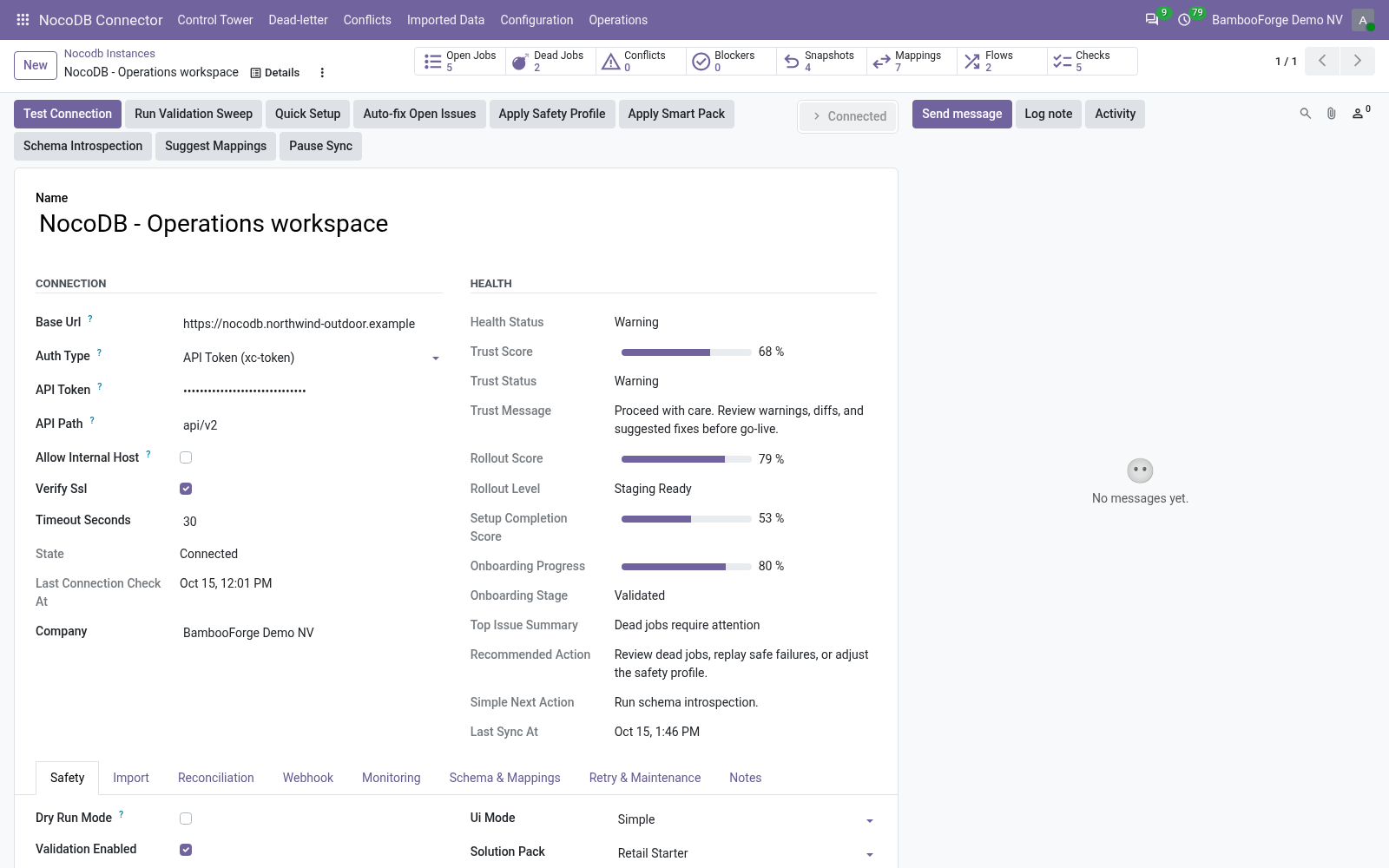
- Dry-run firstA new instance reads NocoDB and keeps what it would write: imports and Row Sync runs write nothing on either side until you untick Dry Run Mode.
bambooforge_nocodb_connector123 automated checks run before every release of this app, the same suite on every series it ships for. The complete list is in the source you receive; run it yourself with --test-enable.
How you use it
Four flows, in the order you will meet them
Connect: one instance per NocoDB server, dry-run first
Test Connection proves the address and the token, and the first import writes nothing.
- In Odoo: NocoDB Connector > Configuration > Instances > New. Enter the server's address and an API token.
- Press Test Connection. The state turns Connected.
- On the Import tab press Queue Base Import, then Queue Table Import.
- Read Operations > Logs, untick Dry Run Mode and import again, bases first.
Bases and tables, with their row counts
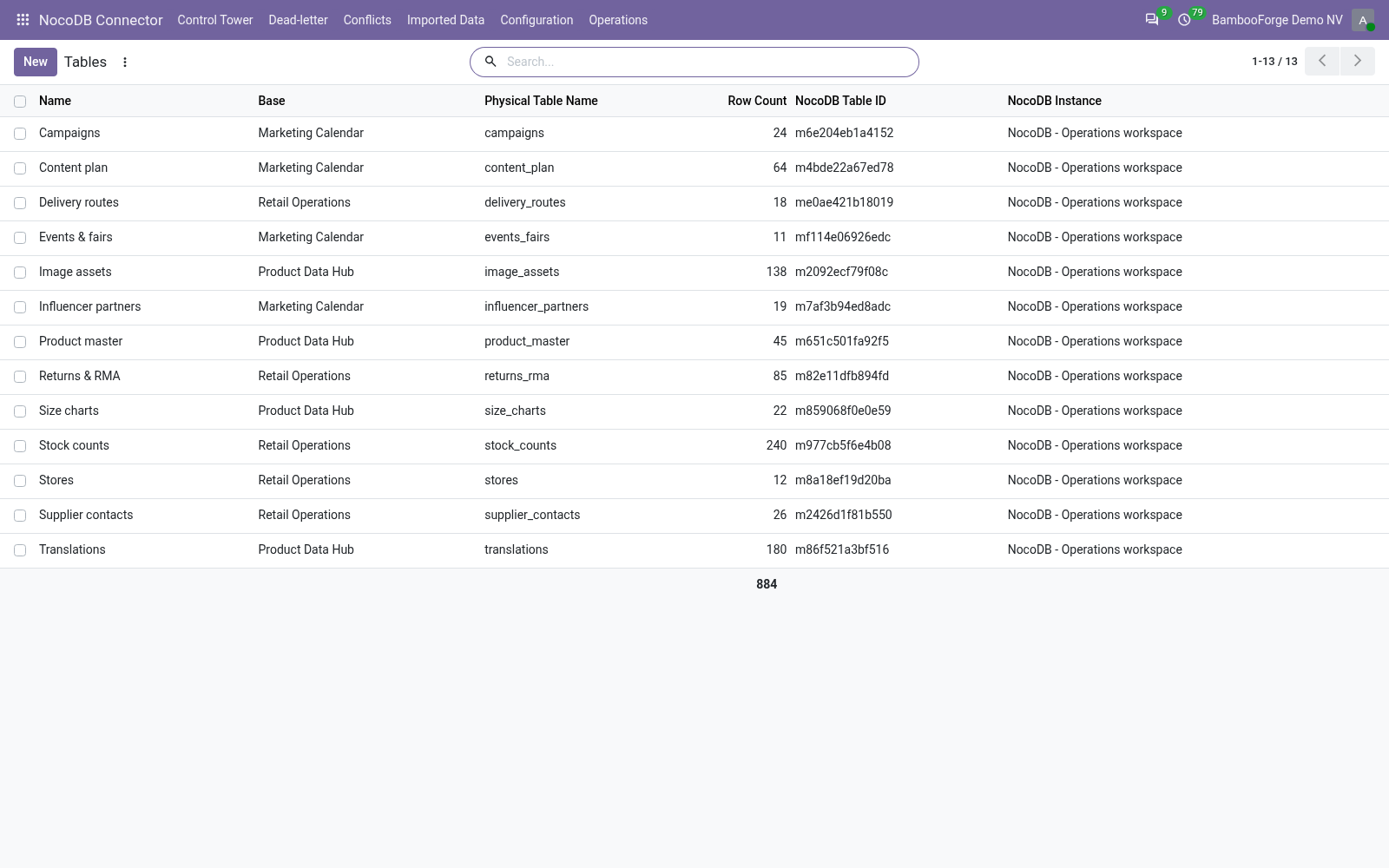
Odoo's copy of NocoDB's names, ids and row counts, searchable and grouped.
- Imported Data > Bases lists each base with its NocoDB id and its number of tables.
- Imported Data > Tables lists each table with its base, physical name, row count and NocoDB id.
- A row count is NocoDB's total for the table at its last import; the list sums them.
Row Sync: one NocoDB table, one Odoo model
A Settings administrator makes the mapping under Configuration > Row Sync; nothing moves before.
- Pick an imported table, an Odoo model, a direction (Import, Export or Bidirectional) and a key column with its Odoo field.
- On the Field Mappings tab, list the columns and the Odoo fields they fill.
- Press Run Now in dry-run: the notification says what the run would create and update.
- Tick Run on Schedule: the NocoDB Row Sync action queues the mapping every 15 minutes.
A failed job lands in a list
Every job is retried, set aside after its last try, and shown with its error.
- Open the Control Tower: one card per instance with its backlog, dead letters and conflicts.
- Open Dead-letter, fix the cause the error names, select the jobs and use Requeue Jobs.
- For Row Sync, Operations > Logs names each row and record that failed, and each pair changed on both sides.
Price and where to buy
89 EUR, one payment per Odoo series, on the Odoo Apps Store. Pick your series:
Twelve months of support by the people who wrote the code; bug fixes and improvements within the series free for as long as it is published. Report a bug within two months of purchase and, if it is not resolved within fifteen days, you get a full refund. Full source under OPL-1, no licence key, no phone-home. The whole promise.