 BambooForge Labs

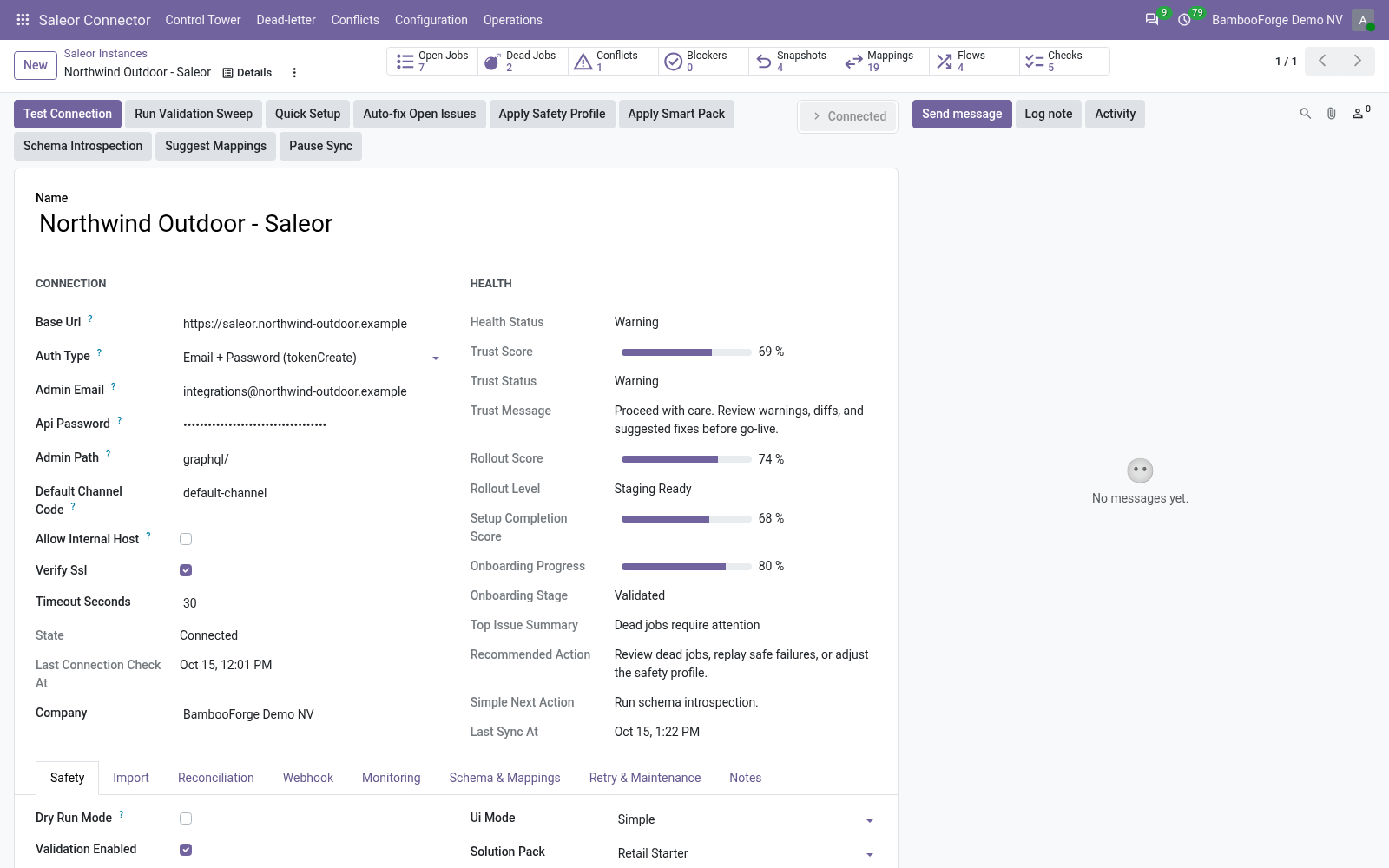
- Dry-run first, on every new storeA new instance simulates every job: no record changes in Odoo, nothing is sent to Saleor, and each job keeps what it would have written. You untick Dry Run Mode when you have read the results.
- Several stores, one Odoo stockOdoo sends each store what it can still sell of each single-variant product: the on-hand less what waits to go out, less a buffer, never below zero. A sale confirmed in Odoo, from any store, lowers what every store is sent within about a minute.
- Orders that add up to Saleor's totalShipping comes in as a line of its own and what still differs (discounts, fees, rounding) as one named line, so the order adds up to what the customer paid. The lines carry Saleor's prices with tax and no Odoo tax unless you turn tax matching on.
bambooforge_saleor_connector265 automated checks run before every release of this app, the same suite on every series it ships for. The complete list is in the source you receive; run it yourself with --test-enable.
How you use it
Four flows, in the order you will meet them
Connect: one instance per store, dry-run first
Test Connection proves the address and the account, and the first sync writes nothing.
- In Odoo: Saleor Connector > Configuration > Instances > New. Enter the server's address, the GraphQL path, the channel, and a staff user's email and password or an app token.
- Press Test Connection. The state turns Connected and Configuration > Order State Mappings gets nine rows for the store; a failure sets Error, and Last Connection Error says why.
- On the Import tab press Queue Customer Import and Queue Product Import. Dry Run Mode is on: each job keeps what it would have written, and Operations > Validation Results lists what the checks found.
- Untick Dry Run Mode on the Safety tab and press the buttons again: the records are written, each with a Saleor tab and a row under Configuration > Binders.
Every order status has a rule, and every order adds up
Saleor gives each order a status; a table per store decides what Odoo does with it.
- Configuration > Order State Mappings holds the statuses Saleor uses, each with Keep draft, Confirm sale order, Cancel sale order or Ignore; an administrator changes a row or adds one.
- An imported order is confirmed, cancelled or left as a quotation by the row of its status; a status with no row is ignored.
- With Match Storefront Totals on, the shipping is a line of its own and what still differs one named line; the total the order had to reach and the difference left stay on its Saleor tab.
One Odoo stock behind every store
Odoo sends each store what it can still sell; a sale in Odoo lowers every store's figure.
- Tick Stock Export Enabled on the Import tab and choose the Stock Source Warehouse, or leave it empty for the whole company.
- A stock move in Odoo starts the push within about a minute, and it runs every 30 minutes: the on-hand less what waits to go out, less the buffer, never below zero.
- Stock Import To Odoo can take the store's figure as Odoo's starting stock; it never runs in dry-run.
A failed job lands in a list, not in silence
Every import, export and stock push is a queue job with its retries.
- A job that fails waits and is tried again with a growing wait; five failures in a row pause the store until it is healthy again.
- Dead-letter lists the jobs that will not run again by themselves; Requeue Jobs sends them back once the cause is fixed.
- Control Tower shows each store's health, backlog, dead letters and conflicts on one card.
Price and where to buy
199 EUR, one payment per Odoo series, on the Odoo Apps Store. Pick your series:
Twelve months of support by the people who wrote the code; bug fixes and improvements within the series free for as long as it is published. Report a bug within two months of purchase and, if it is not resolved within fifteen days, you get a full refund. Full source under OPL-1, no licence key, no phone-home. The whole promise.